
How Boulder Athletes Are Using Chinese Herbal Medicine to Speed Recovery and Build Resilience
Chinese Herbal Medicine for Athletes in Boulder: Performance, Recovery, and Injury Prevention
Boulder's athletic culture runs deep — from competitive triathletes and ultramarathon runners to elite cyclists and mountaineers.
In a community this serious about performance and recovery, Chinese herbal medicine is emerging as a complement to the standard toolkit of sports nutrition and physical therapy.
At Jade Mountain Health, Andrew Maloney prescribes individualized herbal formulas — not off-the-shelf supplements — designed to support tissue repair, reduce inflammation, restore Qi and Blood after heavy training, and strengthen the body's resilience against injury.
This is not a replacement for the work your coach, physio, or nutritionist is doing. It is an additional layer — one with a clinical history stretching back thousands of years and a growing body of modern research supporting its mechanisms.
Here is what Chinese herbal medicine can actually do for athletes, and how it works in practice.
What Chinese Herbal Formulas Support Athletic Recovery and Endurance?
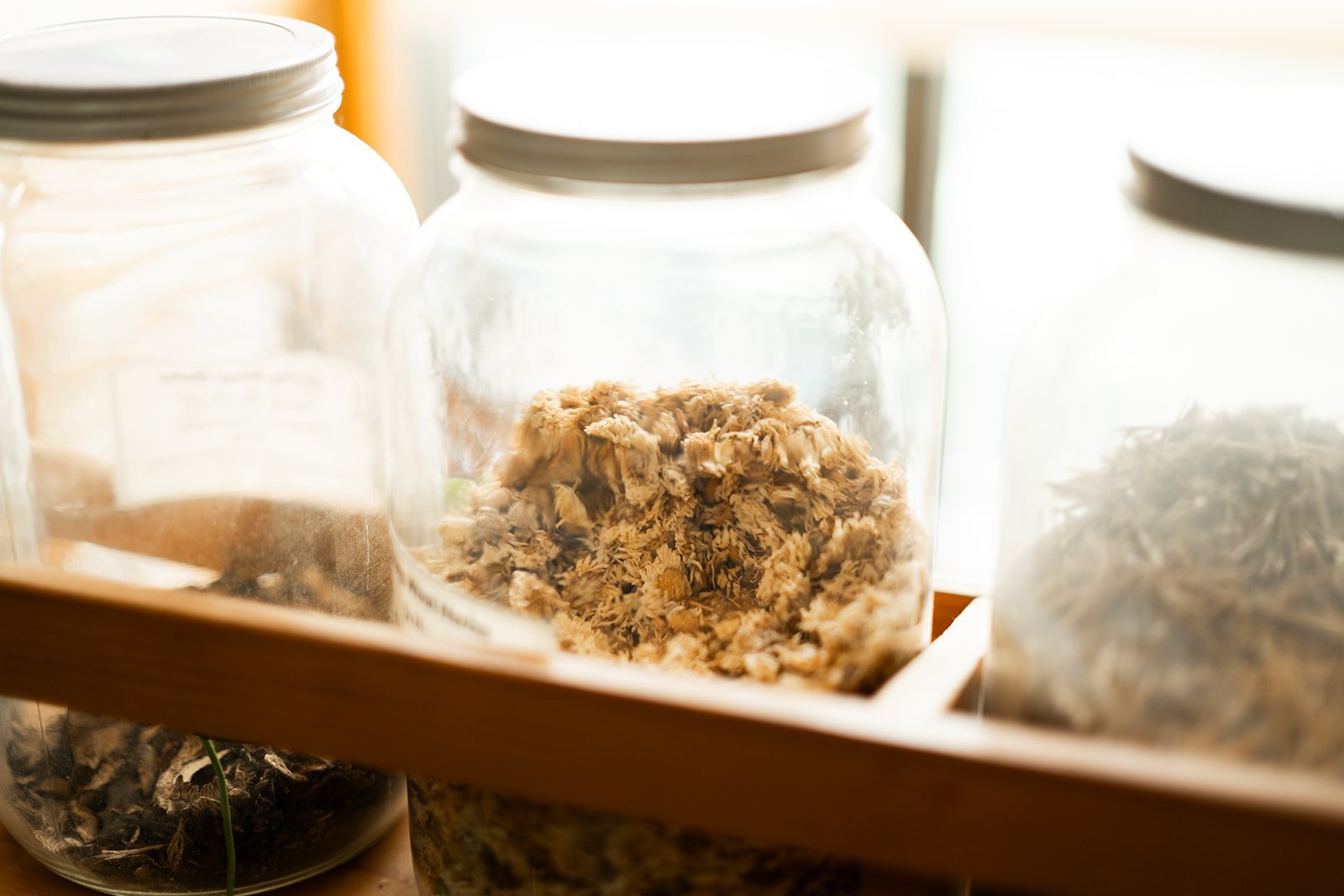
Several classical Chinese herbal formulas have well-established clinical applications for athletic recovery, and the right formula depends entirely on the individual — their constitution, training load, and the specific demands they are placing on their body.
That said, a few broad categories of formulas come up consistently in athletic practice.
For recovery from heavy training and endurance efforts, formulas that tonify Qi and Blood are the most commonly indicated. From a TCM perspective, intense sustained exercise depletes both — Qi is the functional energy that powers muscular activity, and Blood (in the classical sense) nourishes the tissues, supports oxygen delivery, and anchors the mind. Formulas in this category often include herbs like Huang Qi (Astragalus), Dang Gui (Angelica sinensis), and Shu Di Huang (prepared Rehmannia), which work together to restore what heavy training depletes.
For acute soft tissue injury — sprains, strains, tendon irritation — formulas that move Blood and reduce stagnation are typically used first. These are more dispersing in nature and aim to reduce localized swelling and pain, improve circulation to the injured area, and accelerate tissue repair. Formulas like Die Da Wan (trauma pill) and San Qi (Notoginseng)-based preparations have been used for this purpose in martial arts and athletic traditions for centuries.
For athletes dealing with chronic inflammation, adrenal fatigue patterns, or poor recovery between training blocks, the clinical picture gets more nuanced. This is where individualized prescription becomes essential — the formula that supports one runner's recovery may be entirely wrong for another.
The key distinction between Chinese herbal medicine and most sports supplements is that herbal formulas are prescribed to the person, not the symptom. That requires a proper intake and diagnosis, which is exactly how it works at Jade Mountain Health.
How Does Herbal Medicine Work Alongside Acupuncture for Boulder's Competitive Athletes?
Herbal medicine and acupuncture are most effective when used together, and for competitive athletes in Boulder, the combination typically produces faster and more sustained results than either approach alone.
Acupuncture works through the nervous system, connective tissue, and local circulatory mechanisms. It is effective for pain modulation, reducing localized inflammation, releasing muscle tension, and regulating the autonomic nervous system — which matters enormously for recovery, since the shift from sympathetic to parasympathetic tone is what allows the body to repair itself after hard effort.
Herbal medicine extends that effect between sessions. While acupuncture produces an immediate and often significant response, its effects need to be reinforced and built upon over time. Herbs taken daily — typically as a granule concentrate dissolved in water, or as a traditional decoction — maintain a therapeutic influence on the body's physiology that a once-a-week needle treatment cannot replicate on its own.
For an athlete in a high-volume training block, this matters practically. The recovery window between sessions is where adaptation happens. If that window is compromised by poor sleep, lingering inflammation, or inadequate tissue repair, training quality degrades and injury risk rises. Herbal medicine targeted at that recovery window can meaningfully shift the equation.
Research in this area is still developing, but studies suggest that certain adaptogenic herbs used in Chinese medicine — including Astragalus and Eleuthero — support immune function and stress resilience under high physical loads. Clinical evidence also indicates that San Qi (Panax notoginseng) has measurable effects on microcirculation and tissue repair.
The combination of acupuncture and herbal medicine gives Boulder athletes a genuinely integrated recovery protocol, not just two separate treatments running in parallel.
Can Chinese Herbal Medicine Help Prevent Injury, or Is It Only Useful After One Occurs?
Chinese herbal medicine is genuinely useful for injury prevention — and this is one of its most underappreciated applications in athletic contexts.
Most athletes think about herbal medicine reactively, after something has gone wrong. But the classical TCM framework is fundamentally preventive in orientation. The goal is to identify patterns of deficiency, stagnation, or imbalance before they manifest as injury, and to address them while the body still has enough reserve to respond efficiently.
In practice, this looks like identifying athletes who are running on depletion — training hard, sleeping poorly, carrying chronic low-grade fatigue — and prescribing formulas that restore Kidney Jing and Qi before the body reaches the breakdown point. Kidney Jing, in TCM terms, is the deep constitutional reserve that governs tissue integrity, bone density, and the body's capacity to regenerate. Repetitive high-impact training draws on this reserve. Herbal support can help replenish it.
For athletes in Boulder who are managing high mileage or elevation gain — running the Flatirons trails, grinding long climbs on the bike, or preparing for a mountaineering season — this kind of proactive support can make a real difference in how the body holds up over a long training block.
Tendons and ligaments are a particular focus in athletic herbal medicine. These tissues have relatively poor blood supply compared to muscle, which means they heal slowly and are often the limiting factor in an athlete's training. Formulas that tonify the Liver — which governs the sinews in TCM theory — are frequently used to maintain tendon health and resilience in high-volume athletes.
The earlier you start, the more effective this approach tends to be. Waiting until something tears means starting from a much deeper deficit.
Jade Mountain Health is located in the Wonderland Hills neighborhood in North Boulder, off Broadway and about ten minutes from Pearl Street. If you are a Boulder athlete looking to strengthen your recovery, manage an injury, or build more resilience into a heavy training block, we would be glad to talk through what Chinese herbal medicine might offer you specifically.
Andrew Maloney brings deep training in classical herbal medicine to every patient consultation — and the formulas prescribed here are individualized, not generic. Reach Jade Mountain Health at (303) 859-3125 or schedule directly at jademtnhealth.com.
Frequently Asked Questions About chinese herbs for athletes
-
When prescribed appropriately by a trained practitioner, Chinese herbal medicine is generally well tolerated and can be integrated safely into an athlete’s broader recovery and training plan. At Jade Mountain Health, formulas are individualized based on the athlete’s constitution, training load, symptoms, and health history rather than prescribed generically.
-
Chinese herbal medicine is commonly used to support recovery from intense training, soft tissue strain, fatigue, and prolonged physical stress. Depending on the presentation, formulas may be used to support circulation, tissue repair, sleep quality, immune resilience, and recovery capacity between training sessions.
-
Yes. Many athletes combine acupuncture and Chinese herbal medicine because the two approaches work differently but complement one another well. Acupuncture is often used for pain modulation, muscle tension, and nervous system regulation, while herbal medicine provides ongoing support between treatments through daily therapeutic use.